

You’ve spent years, maybe decades, building your business. So it’s worth asking a question most business owners never sit down and answer: what is it actually worth, and what could it be worth?
I’m Scott Davison, a Certified Exit Planning Advisor and former COO. I help business owners increase the value of their business and prepare for a successful exit. And the first step in the process is always to start with a valuation and value gap analysis.
Most business owners can tell you their Revenue and profit numbers without blinking. Far fewer track a third number that matters just as much: Business value, what a buyer would actually pay for the business today. The gap between what your business is worth now and what it could be worth is what’s known as ‘the value gap’. Closing that gap, and increasing the value of your business before you sell, is what this article is about.
For a free “value gap” analysis – click here. For a more detailed and thorough valuation, please book a call.
How are businesses valued?
At its core, it comes down to two questions: what return can you expect from the business, and how risky is that return? The formula is: Business Value = Earnings x Multiple
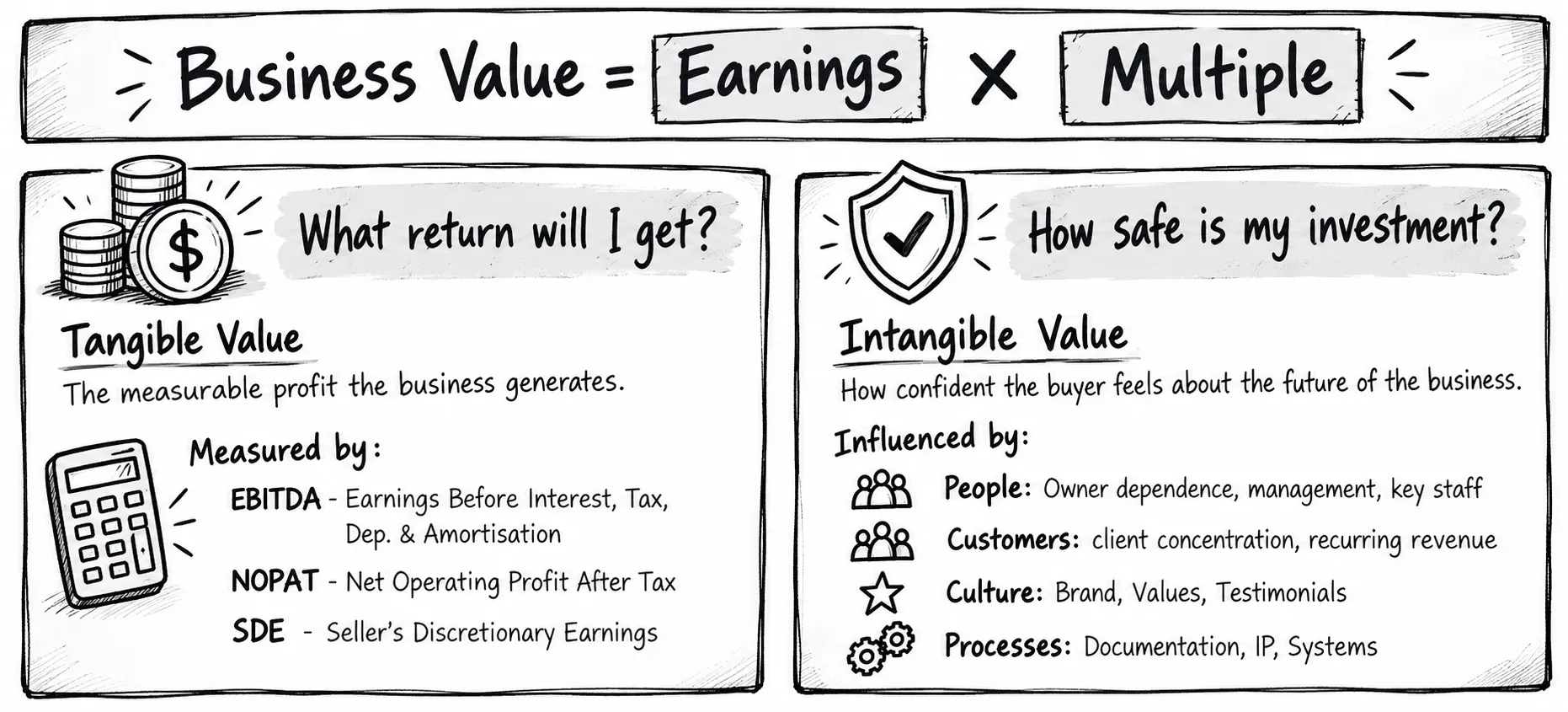
Earnings is your profit, most commonly measured as EBITDA (Earnings Before Interest, Tax, Depreciation and Amortisation) for larger businesses, or SDE (Sellers Discretionary Earnings) for smaller ones. (For a plain-English explainer on how EBITDA is calculated, see Corporate Finance Institute’s guide.)
The Multiple is harder to pin down, because it’s really a measure of risk: how confident a buyer feels that your earnings will keep showing up once you’re gone. The range of multiples varies by industry and by the size of the business. Current market conditions will also have an impact. So whilst you can’t control some of these factors, there are 7 things that you can directly influence, which can significantly increase the multiple you achieve.
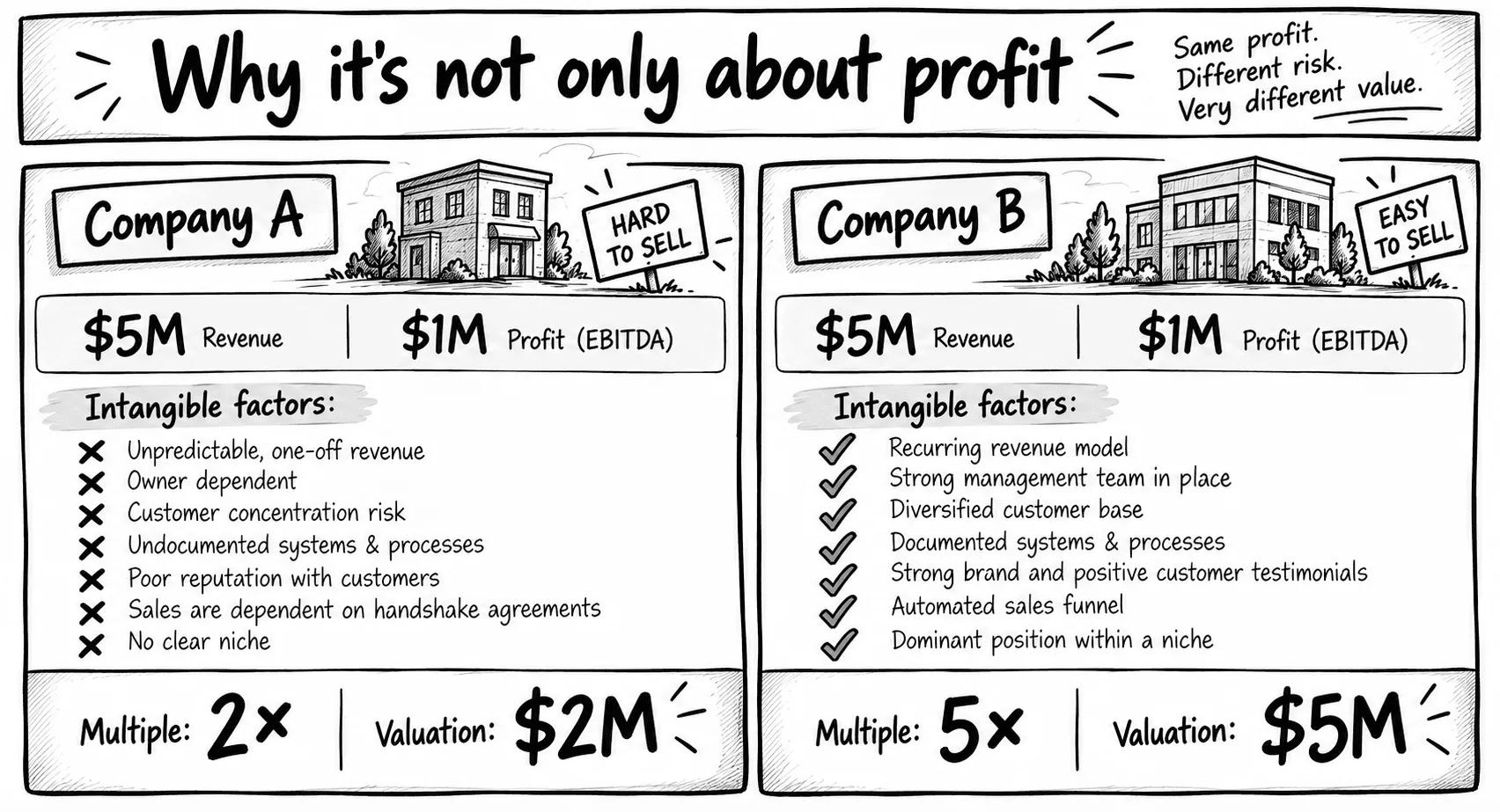
In the example above, two businesses of the same size, operating in the same industry, can sell for very different amounts, because one looks safe to a buyer and the other looks fragile. Here are the 7 things that will increase Business value ahead of a sale.
| # | Lever | How it helps increase value |
|---|---|---|
| 1 | Present strong financials | Upwards trajectory and clean books instill confidence and reduce perceived risk. |
| 2 | Reduce owner dependence | Removes key person risk |
| 3 | Reduce customer/supplier concentration | Removes concentration risk |
| 4 | Document systems and processes | Reduces transferability risk |
| 5 | Grow intangible assets | Directly increases the value of the business to a potential buyer |
| 6 | Systemise your sales funnel | Provides future revenue certainty |
| 7 | Own a niche | Reduces competitive risk and drives up strategic value to a buyer |
1. Present strong financials
Businesses are typically valued and traded based on a multiple of Revenue or Profit. So ideally you want both of these metrics moving up and to the right.
Top line growth is particularly important, as nobody wants to buy a declining business. Or if they do, they are going to offer a much lower Price.
But beyond simply growing your Revenue and profit, here are some key things that will help improve the quality of your financials and contribute to a higher multiple.
Ensure your books are clean
A buyer will examine your numbers closely, so it’s important they can trust them. If you don’t have a professional accountant overseeing your books, now is a good time to start. At some point your books may need to be audited, so make sure someone properly qualified is across them.
If you have been running your business as a lifestyle business, with the profit going to the owner, then it’s normal that you will have been adding in discretionary expenses and reducing profit to minimise tax. Your books will be “normalised” as part of a sales process, to include ad backs and deductions, and as long as that can all be explained, it’s not a major issue.
But if you have time to prepare for your exit, then ideally you want to have three years of clean financials that accurately reflect your real profit number.
It comes down to reducing perceived risk. So if your books can be professionally presented, with supported data and no skeletons, the potential buyer can feel more confident.
Improve Revenue Quality
Whilst revenue is crucial, not all revenue is created equal in the eyes of a buyer. One-off revenue you have to keep chasing is considered unreliable. Recurring revenue, such as subscriptions, memberships or long term contracts, is considered far safer, and it reduces the risk a buyer sees in your business.
Building more recurring revenue into your model won’t just help you sleep at night. It will directly increase what a buyer is willing to pay.
Working capital and Cash Flow
Most business owners learn very early on the importance of cash flow. Cash is the oxygen of the business. Even if your top line numbers are healthy, unless you have enough cash to keep the business running, things can fall over pretty quickly.
So cash flow is a metric worth managing in any case. It makes your business less stressful to run and easier to scale. But when it comes to selling, a healthy cash flow position is a real factor in what your business is worth.
Here’s why. When a buyer works out what they’re prepared to pay, they’re not just pricing the purchase price. They’re also pricing what it’ll cost them to keep the business running from the day they take over, stock on hand, invoices out, bills to pay. That’s cash they need to find, on top of whatever they pay you for the business itself.
So the less cash your business needs tied up in day-to-day operations, the more attractive it looks. If your business is cash hungry, that works against you at the negotiating table. Buyers factor this in, so it’s worth getting ahead of it well before you go to market.
Working capital needs vary a lot by industry, but there are three levers most businesses can pull to improve cash flow:
- Speed up receivables – tighten your invoicing and collection process so cash comes in faster.
- Slow down payables – negotiate better terms with suppliers so cash goes out later.
- Right-size your inventory – hold stock that matches actual demand, rather than cash sitting on a shelf.
2. Reduce owner dependence
Outside of your finances, this is the number one factor that can hurt both the value of your business and how attractive it is to a buyer. In fact many great businesses simply can not be sold, because they are too dependent on the owner.
Whilst there are some ‘lifestyle buyers’ looking to buy themselves a job, most serious mid-market buyers want a business that will run itself once the owner is gone.
And from your perspective, as the owner, ideally you want to be able to sell the business and get most of your cash upfront. Whilst it’s quite normal to have some sort of earn-out period, the less dependent the business is on you, the stronger your position at the negotiating table.
Like everything on this list, this isn’t just good exit planning. It’s good business. Imagine having a business that can run without you. Even if you are not looking to sell, this gives you freedom, less stress and more options.
A good reality check is to ask yourself this: “if you disappeared for six weeks, would the business fall over?” If the answer is yes, then unfortunately what you have is a “job” not an “asset”. (For more on how buyers assess this specifically, this piece on key person risk is worth a read.)
Owner dependence is a common issue with most owner operated businesses. But with time and focus it can be addressed. Now is a good time to start.
Again, what we are trying to do here is reduce risk, in this case key person risk. It applies mostly to the owner, but also to any key staff. Ideally, wherever possible you want redundancy built in.
Often the first step is to hire a General Manager who can gradually take over most of the day to day decisions that are dependent on the owner. If you can build a management team, with other potential leaders, even better.
Document job roles, KPIs and standard operating procedures, so no single staff member is a point of failure.
And a great way to encourage key staff to stick around is to build in long term incentives into their contracts.
Whatever you can do to empower your team to make decisions, without you, is helping to reduce owner dependence and drive up company value.
3. Reduce customer/supplier concentration
A buyer evaluates your business by asking one blunt question: what could go wrong? What happens if you lose a key customer, or a key supplier?
For this reason, it’s important not to be too reliant on any one customer. The safe ratio will vary by company type and industry, but a good rule of thumb is no more than 20% of revenue from one customer. If one or two key customers drive the majority of your revenue, that’s a risky scenario for a buyer and will reduce the value of your business. So start looking for ways to diversify your customer concentration where possible.
The same logic applies to your supply chain. It’s normal to have key suppliers and partners, but if your business is too reliant on one key partner it adds risk, because what would happen if that supplier went out of business or suddenly increased their prices?
Again, this is not something that can be addressed overnight, but if you are building towards a future exit, or just looking for ways to de-risk your business, reducing customer and supplier dependency is a really good way to do this.
4. Document Systems and Processes
When you describe your business, you probably start by explaining “what” you do. But when it comes to valuing your business, the “way” you do things really matters. A valuable business has specific processes for delivering its product or service, and these need to be transferable to a new owner. A good way to do this is to document them via SOPs (Standard Operating Procedures).
Also consider whether there is anything in your business that could be patented or trademarked. Do you have a unique system, technology or a “secret sauce” that you use to deliver your product or service?
Start documenting these things now. Put all your key contracts, trademarks, domain names, SOPs into a centralised shared drive. It’s exactly the kind of thing that is going to be required during the Due Diligence process, so it pays to get organised early.
These are often the important but not urgent tasks that owners have intended to do, but never get around to. Once you see the direct link to Business value, it’s easier to prioritise, even if it means delegating the work to someone else.
A buyer wants to know that the business will keep functioning and producing after it moves to a new owner. Being able to demonstrate repeatable processes and well tested systems lowers the risk a buyer sees in your business, and that drives up value.
5. Grow intangible assets
A huge amount of your Business value is tied to intangible assets. These are often hard to measure, as they don’t appear on the company balance sheet. But to a buyer, this is where a lot of the value resides.
Intangible assets include things such as your brand, your reputation, referrals and goodwill. You can demonstrate these through customer testimonials, Google ratings, and a measure such as Net Promoter Score (NPS).
Email lists, social followings and online ratings aren’t vanity metrics. Growing them directly increases what a buyer will pay for your business.
And don’t overlook the value of your brand. First impressions count, and this is the same when you try to sell your business. Doing a bit of a brand refresh and making sure your website is looking professional are important things to consider before taking your business to market.
6. Systemise your sales funnel
Your P&L shows what sales you’ve generated in the past. A buyer cares about whether that will continue. For this reason it’s important to be able to demonstrate a tried and tested sales and marketing funnel.
Whether you generate leads through Google Ads, email, face-to-face meetings or another channel, what matters is understanding your numbers and being able to demonstrate how the system works.
If sales depend on the owner’s relationship with clients, that has little value to a new buyer, since the moment the owner leaves, the sales dry up. A system for generating leads and converting them into clients is the opposite: it’s something that increases both the attractiveness and the value of your business.
Do you collect emails and contact details of potential clients? Do you have a CRM? Do you have a system for converting leads into sales?
If you can show this, with evidence, it will make your business more attractive and more valuable to a buyer.
7. Own a niche, specialise don’t generalise
It can be tempting to try to be everything to everyone. But when it comes to selling your business, owning a clear niche or a dominant position within a specific market means you’re more likely to fetch a higher price.
The type of company that would consider acquiring your business is most likely a larger one, and that’s a good thing: they have deeper pockets and more resources to help scale your business to the next level.
The best way to drive a higher price from a strategic buyer is to be strong where they are weak. Owning a niche, or a specific market segment, is how you do that.
Some business models are based on scale (low cost, high volume) like the McDonald’s model. Others are considered boutique, with lower volume and a higher price. Either model can be successful. What doesn’t work is being stuck in the middle.
For a lot of SMEs, the boutique model is a good place to be, as you possibly can’t compete with the big guys purely on price, but you can differentiate yourself on quality.
It’s important to be clear about where your business sits on this spectrum so that you can make strategic decisions and plans.
Begin with the end in mind
Most business owners don’t calculate the value of their business until they decide they want to sell it. But it shouldn’t be that way.
Understanding what your business is worth, and what it could be worth, matters at every stage of the business, not just when you’re ready to sell. It’s a crucial step towards building a valuable business asset.
Tracking this number over time lets you make strategic decisions and measure real progress, not just guess at it.
If you want to get a rough estimate of what your business is worth and what it could be worth – complete the free value gap assessment.
Or book a time to speak with me and I’ll explain the process I use to do a thorough valuation and a detailed plan of how your business rates on key metrics compared to industry benchmarks.
Even if you are not looking to sell right now, understanding Business value and tracking it on an annual basis is a great way to ensure you are moving your business in the right direction for a successful and profitable exit in the future.